Connection and Dis-Connection

‘On Margate Sands
I can connect
Nothing with nothing.
- T.S. Eliot, The Waste Land (1922)
In 1921 in a psychiatric hospital in Zurich, Switzerland, Hermann Rorschach invented the inkblot test, which involves showing a subject a series of abstract splatters of ink on a page and inviting the subject to describe what they see. In Rorschach’s test, the subject makes concrete that which is abstract, and in that meaning-making process, Rorschach is able to catch a glimpse of the inner workings of the subject’s mind.

Look at the inkblots above. Do you see two people praying? Do you see a racecar? One of those spaceships from Galaga? Do you see someone covering their face as they cry? All these conclusions you make are projections of your inner psychological landscape onto this abstract image.
What is poetry but a series of inkblots on a page?
Whatever the abstraction, whether it be imagery or poetry, I believe the result is the same: the ensuing interpretation says more about the interpreter than the interpreted.
Take the poem excerpt from T.S. Eliot’s The Waste Land: “I can connect / Nothing with nothing.” What does this mean to you? What is the speaker trying to communicate?
There are two broad categories of answers, depending on which line you emphasize:
1. “I can connect / Nothing with nothing” is profoundly optimistic.
2. “I can connect / Nothing with nothing” is profoundly depressing.
It’s a Rorschach test, and apparently, I’m depressed. How fun.
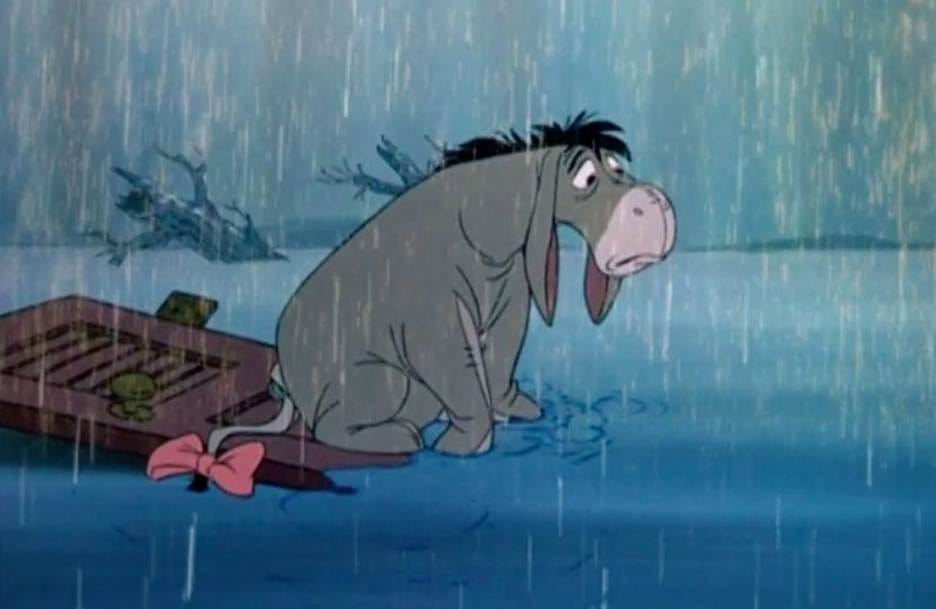
Many today lament our inability to make connections as if it were a modern phenomenon. Certainly, the advent of social media and then smart phones and then algorithms designed to suck every ounce of our attention has something to do with it. Intelligent folks like Jonathan Haidt, Andy Crouch, and others have written about this ad nauseum.[i][ii]
As nauseated as I feel when I receive my Screen Time Report each week, I believe this inability to connect is not an altogether new phenomenon. However parasitic these technologies prove to be, I do not believe they have not created an entirely new situation but instead have simply exacerbated a problem endemic to life in a fallen world.
We have competing desires. We are divided between two kingdoms.
We have this desire for the good things of God, but it is at war with another, alien, pernicious desire for sovereignty over our own lives. We say at once alongside David, “Show me your ways, Lord, teach me your paths,”[iii] and at another time with William Ernest Hensley, “It matters not how strait the gate, How charged with punishments the scroll, I am the master of my fate, I am the captain of my soul.”[iv]
Though it is easy to describe these two desires as if they are neatly discernable, I don’t necessarily experience them as discreet voices in a given situation. More often than not, I feel one tumbling over the other, almost as if there is a sound of a beautiful song—some Gershwin or Count Basie—playing over a gramophone through a neighbor’s open window while an Obscurus[v] swirls violently around me in the alley one street over. I resonate with how Paul describes his own experience to the Romans:
“So I find this law at work: Although I want to do good, evil is right there with me. For in my inner being I delight in God’s law; but I see another law at work in me, waging war against the law of my mind and making me a prisoner of the law of sin at work within me.”[vi]
While I am wired for connection, while I am designed for community, I see another law at work in me: this is the law of dis-connection. The need to escape, to shut down, to zone out, to cordon off my life from yours and yours and yours… the need to distance myself from connection, to dis-connect.[vii]
This is certainly reflected in my actions. Listening to an audiobook instead of calling a friend, binging “White Collar”[viii] on Netflix with my wife instead of going for a walk, leaving my office door closed instead of open, scrolling YouTube Shorts instead of visiting a neighbor, and on and on it goes. My weekly Screen Time report is merely a symptom of the deeper desire to just unplug.[ix]
I am not discounting the factors which lie outside my control—or yours for that matter. In a 2023 report titled, “Our Epidemic of Loneliness and Isolation,” the United States Department of Health & Human Services identified 28 factors that shape our social connections.[x] Every single one of those 28 factors is out of our control. There are many meta-level forces which influence our decisions. We cannot dismiss these realities.
The need to escape, to shut down, to zone out, to cordon off my life from yours and yours and yours… the need to distance myself from connection, to dis-connect.
However, we also cannot dismiss our responsibility in light of these realities. Yes, there are at least 28 factors which are outside of my control which play a significant role in the composition of my social landscape. But, I must still take responsibility for the ways I have self-selected disconnection and loneliness, for the role I have played in creating the present circumstances. My average Tuesday evening is the sum of the choices I’ve made every other Tuesday.
Why do I feel dis-connected?
Because I have chosen dis-connection.
Hensley may be right: Maybe I am the captain of my own soul. If so, I’m a bad one. I have heard the siren song of personal sovereignty and run the hull of my life into the rocks of isolation. And it’s only when I am wrecked on the shore that I can see with any clarity the role I’ve played in leading myself here.
The Loneliness Epidemic is real.[xi] When I read “I can connect / Nothing with nothing,” that feeling of despair, of dis-connection, is real. Yet, to whatever degree it is self-selected, it can be un-selected. This other law that is at work within me: it can be resisted. I can make different choices. We can make different choices.
We can choose to connect—not perfectly, not without failure, not without difficulty—but we can connect. We can put our phones down. We can open our office doors. We can go on walks. We can host our neighbors for coffee. Or offer to mow their lawn. Or simply learn their names.
Will we be able to connect nothing with nothing? I doubt it—that seems like a logical impossibility—but maybe we’ll start to see those inkblots with a little more optimism in our hearts. Have I solved loneliness? By no means. Even as I finish writing this, I feel the draw to pull out my phone and run through my usual Instagram-LinkedIn-YouTube-Instagram-LinkedIn-YouTube cycle.
But is this a step in the right direction? I think so. At the very least, it feels like a step towards a better average Tuesday.
[i] For reference, read The Anxious Generation by Jonathan Haidt or The Life We’re Looking For by Andy Crouch. These are good starters. Jean Twenge’s book iGen is also a great introductory resource. Perhaps I will return to the role of technology in a future post. For now, it should suffice to say that I know it plays a role—and this is a role I am not planning to address in this reflection.
[ii] Just a few days ago, John Green published a video essay on the dark side of technology just a few days ago that is a good watch. It’s titled “Am I Cigarettes?” and you can watch it here.
[iii] Psalm 25:4-5 (NIV)
[iv] From “Invictus” by William Ernest Hensley
[v] From “Fantastic Beasts and Where to Find Them” (2016). If you need a refresher (or if you don’t care about spoilers), you can watch this clip. Hint: it’s the scary black thing.
[vi] Romans 7:21-23 (NIV)
[vii] Now, I recognize there is a healthy, even God-ordained, balance of solitude and community, and the level of this balance varies from individual to individual. I hope it is obvious by context that I am referring here to an unhealthy desire for solitude as a movement away from something good rather than the healthy desire for solitude as a movement towards something good, namely the presence of God.
[viii] Perhaps this is a bit hypocritical (it definitely is), but if you are looking for a great show, you need to check out “White Collar.”
[ix] Ironic, right?
[x] https://www.hhs.gov/sites/default/files/surgeon-general-social-connection-advisory.pdf
[xi] There’s so many studies on this. One oft-cited (7,411 citations) article from BYU claims that loneliness is a stronger risk factor for mortality than smoking 15 cigarettes per day (Holt-Lunstad J, Smith TB, Baker M, Harris T, Stephenson D. Loneliness and social isolation as risk factors for mortality: a meta-analytic review. Perspect Psychol Sci. 2015 Mar;10(2):227-37. doi: 10.1177/1745691614568352. PMID: 25910392.)